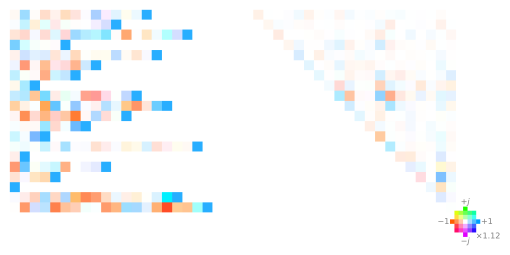
Visualizing Linear Algebra Decompositions
In this notebook we just demonstrate the utility function xyzpy.visualize_matrix on
various linear algebra decompositions taken from scipy. This function plots matrices
with the values of numbers directly mapped to color. By default, complex phase gives the hue,
with
real positive = blue
real negative = orange
imaginary positive = purple
imaginary negative = green
whereas the magnitude gives the saturation, such that \(|z| \sim 0\) gives white.
%config InlineBackend.figure_formats = ['svg']
import numpy as np
import scipy.linalg as sla

import xyzpy as xyz

rng = np.random.default_rng(42)
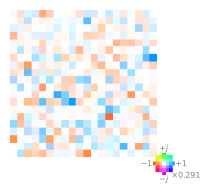
First we’ll start with a non-symmetric random matrix with some small complex parts:
X = 0.1 * rng.normal(size=(20, 20)) + 0.01j * rng.normal(size=(20, 20))
xyz.visualize_matrix(X, figsize=(2, 2));
Singular Value Decomposition
xyz.visualize_matrix(sla.svd(X), figsize=(8, 6));
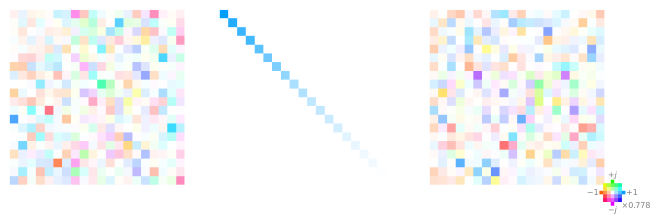
The 1D array of real singular values in decreasing magnitude is shown as a diagonal.
Eigen-decomposition
xyz.visualize_matrix(sla.eig(X), figsize=(6, 4));
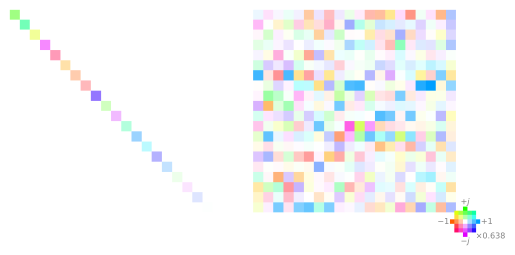
Here we see the introduction of many complex numbers far from the real axis.
Schur decomposition
xyz.visualize_matrix(sla.schur(X), figsize=(6, 4));
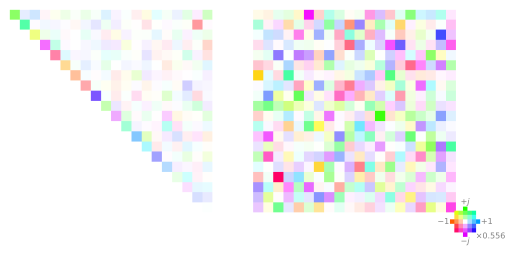
If you look closely here at the color sequence of the left diagonal it follows the eigen decomposition.
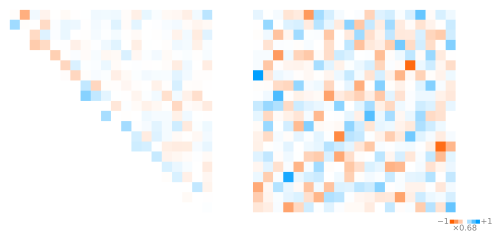
xyz.visualize_matrix(sla.schur(X.real), figsize=(6, 4));
QR Decomposition
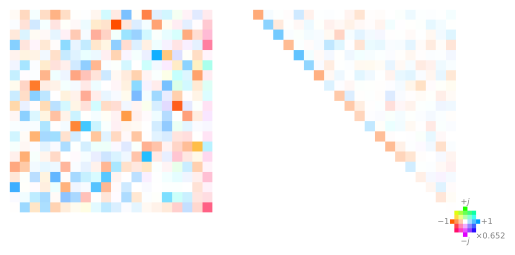
xyz.visualize_matrix(sla.qr(X), figsize=(6, 4));
Polar Decomposition
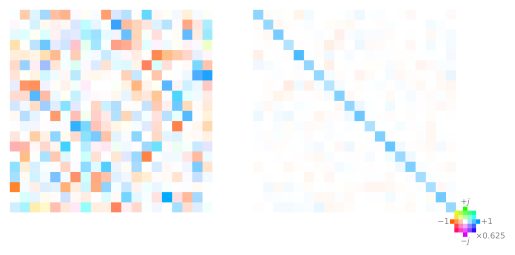
xyz.visualize_matrix(sla.polar(X), figsize=(6, 4));
LU Decomposition
xyz.visualize_matrix(sla.lu(X), figsize=(8, 6));
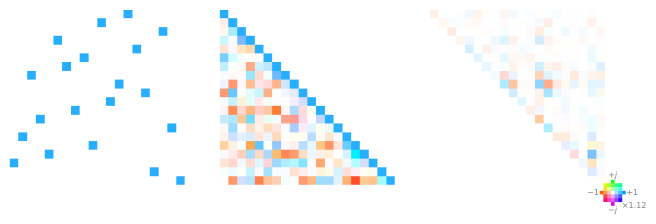
Multiplying the left matrix in reorders the rows of the \(L\) factor:
xyz.visualize_matrix(sla.lu(X, permute_l=True), figsize=(6, 4));