Basic Output Example
This example show the simplest way to go from a function and set of parameter
combinations to a labelled xarray.Dataset.
Imagine we want to explore the function scipy.special.eval_jacobi(). It takes four different arguments and we want to get a feel for what each does. First we wrap it in a Runner object, that encapsulates how to run all the different combinations of its arguments and automatically labels the output.
%config InlineBackend.figure_formats = ['svg']
from scipy.special import eval_jacobi

import xyzpy as xyz


def jacobi(x, n, alpha, beta):
    return eval_jacobi(n, alpha, beta, x)


r = xyz.Runner(jacobi, var_names="Pn(x)")
r
<xyzpy.Runner>
    fn: <function jacobi at 0x10c31c880>
    fn_args: ('x', 'n', 'alpha', 'beta')
    var_names: ('Pn(x)',)
    var_dims: {'Pn(x)': ()}
This is as simple as it gets, the function jacobi has one output variable, which we are calling 'Pn(x)'.
Now let’s define all the different values we want to try for each argument (the function actually vectorizes over x so this is overkill, but serves as a good demonstration):
import numpy as np

combos = {
    "x": np.linspace(0, 1, 101),
    "n": [1, 2, 4, 8, 16],
    "alpha": np.linspace(0, 2, 3),
    "beta": np.linspace(0, 1, 5),
}
Now, let’s run the function for every combination of the above parameters:
r.run_combos(combos)
100%|##########| 7575/7575 [00:00<00:00, 594077.39it/s]
<xarray.Dataset> Size: 62kB
Dimensions:  (x: 101, n: 5, alpha: 3, beta: 5)
Coordinates:
  * x        (x) float64 808B 0.0 0.01 0.02 0.03 0.04 ... 0.97 0.98 0.99 1.0
  * n        (n) int64 40B 1 2 4 8 16
  * alpha    (alpha) float64 24B 0.0 1.0 2.0
  * beta     (beta) float64 40B 0.0 0.25 0.5 0.75 1.0
Data variables:
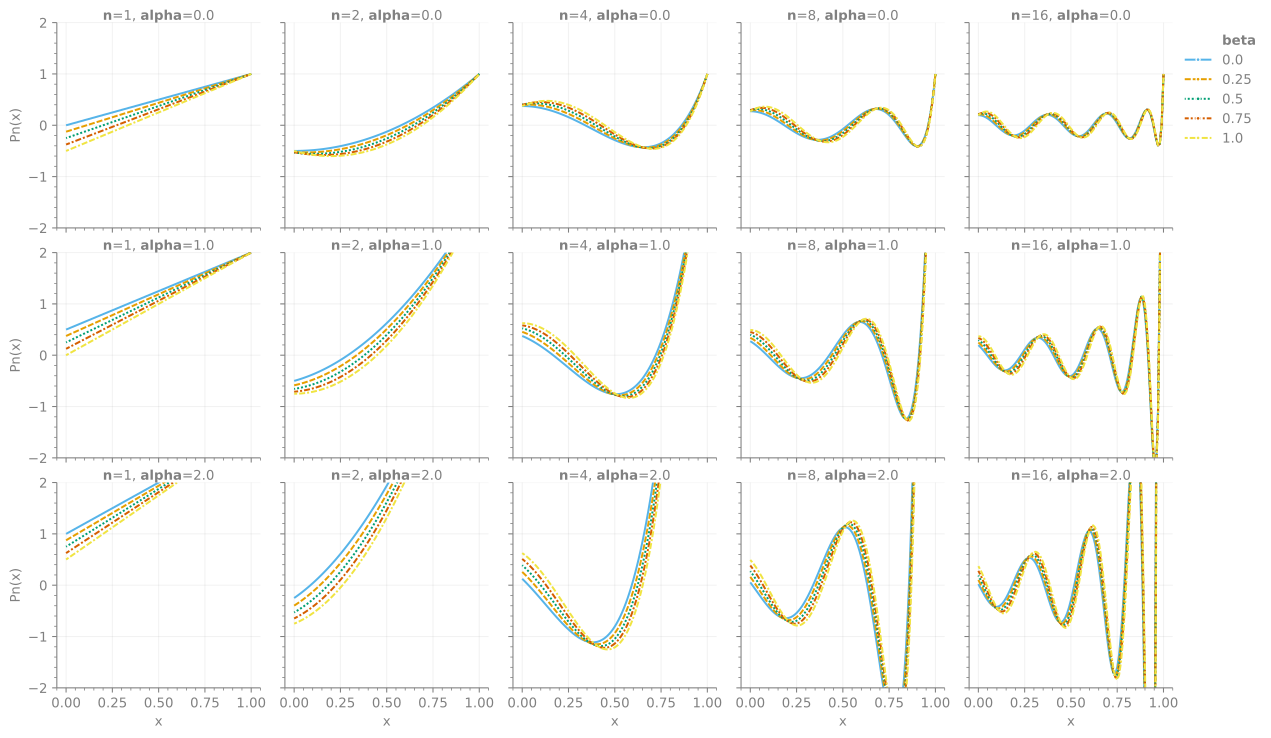
Pn(x) (x, n, alpha, beta) float64 61kB 0.0 -0.125 -0.25 ... 153.0 153.0The resulting dataset is stored in r.last_ds and is an automatically labelled n-dimensional xarray.Dataset. Let’s interactively plot what we have, showing the effect of all four dimensions:
fig, axs = r.last_ds.xyz.plot(
    x="x",
    y="Pn(x)",
    color="beta",
    linestyle="beta",
    col="n",
    row="alpha",
    marker="",
    ylim=(-2, 2),
)